A US customer asks for the ECCN of something you build in Europe. A colleague forwards the email with one line on top: what is our EU ECCN?
The question is simpler than it looks, once you separate two lists that everyone mixes up: the US control list and the EU dual-use list. This article follows on from our ECCN guide.
The Short Answer
- The ECCN is American. It is the designation, in the US Export Administration Regulations (EAR), of the export classification code of an item subject to the EAR: 9A004, 5A002, 3A001 and so on. An item subject to the EAR but not on the US list (the Commerce Control List, or CCL) is designated EAR99, which goes in the same place.
- In Europe, the code is the dual-use classification code, the entry in Annex I of Regulation (EU) 2021/821. It decides whether an export outside the EU needs an authorisation, which in France is issued by the SBDU (Service des biens à double usage).
- Out of habit, many European companies call their dual-use code an “ECCN” as well. The usage is established and people understand each other, but a dual-use code is still a European code. Always say which list your code comes from.
- The two codes can be the same or different, because the EAR and the EU Regulation are not identical.
- Some series exist only on the US side, notably the 515 and 600 series (9A515, 9A610 and so on). In Europe, those products are either classified under other codes or not classified at all.
The rest of the article walks through these five points, with a space example where one box gets two different codes, each correct in its own system.
Why the Codes Often Look Alike
Both lists share the same skeleton: a digit for the category (0 for nuclear through 9 for aerospace and propulsion), a letter for the group (A for equipment through E for technology), then three digits for the entry. Our ECCN guide walks through the anatomy.
They also share a common origin. Annex I implements commitments made in the international control regimes, the Wassenaar Arrangement among them, and the US list draws on the same regimes. So 3A001, 5A002 or 9A004 exist on both sides, often with near-identical text.
Near-identical is not identical. Each list is law in its own system, is amended on its own calendar and carries its own notes, decontrols and licensing rules. The code on one side tells you where to start reading on the other. The answer has to come from each list separately.
Where the Codes Part Ways
- The 515 and 600 series, US only. They hold spacecraft items (9A515) and military items (the 600 series, such as 9A610 for military aircraft) that the US moved from its Munitions List (ITAR) into the EAR. Annex I has no 515 entry and no 600 series. In Europe, military items fall under the Common Military List of the European Union and national war-material lists, some spacecraft items fall under 9A004, and others are not classified at all.
- US entries numbered 900 to 999. They carry controls only the US applies, anti-terrorism among them. A common case: 5A992.c, for mass-market encryption. The EU handles those products through the Cryptography Note in Category 5, which takes them out of 5A002, leaving them with no dual-use code at all.
- EU codes that carry a different number in the US. Since 15 November 2025, Annex I has entries with a 5 in third position. Quantum computers sit there under 4A506, while the US list places them under 4A906, with the same thresholds word for word. Same item, two codes. And on the US side, a 5 in third position (as in 9A515) means something else entirely: firearms, spacecraft and related items.
And EAR99?
EAR99 designates an item subject to the EAR that is not on the CCL. It is not a free pass: an EAR99 item can still need a US licence depending on the destination, the end user or the end use.
The EU has no EAR99. An item missing from Annex I is simply not classified, with no code to write. That does not make it free to ship: the Regulation’s catch-all clauses (Articles 4 and 5) and national lists (Articles 9 and 10) can still apply. The closest EU counterpart to EAR99 is a two-part statement: not listed in Annex I or on a national list, and no catch-all triggered for this shipment. The first part describes the product; the second has to be checked for every transaction.
Worked Example: One Attitude Control Unit, Two Codes
A small company near Toulouse designs an attitude and orbit control unit for small commercial satellites. A US satellite integrator wants twenty and asks for the ECCN.
The EU side. Entry 9A004 of Annex I covers spacecraft and their equipment. Its paragraph e.3 covers on-board equipment “specially designed for ‘spacecraft’” that performs “attitude and orbit control”. Once the war-material question is ruled out, the unit’s dual-use code is 9A004.e.3, and exporting it outside the EU needs an authorisation (our export licensing guide sets out the general picture).
The US side. The CCL has a 9A004 too, with an almost identical e.3. If the two regulations were identical, the answer would be the same on both sides. They are not: a note in the US entry says these paragraphs are there only for harmonisation with Wassenaar, and that the controls actually sit under 9A515. The CCL order of review then sets the path:
- The US Munitions List (ITAR) comes first. Some high-precision attitude control systems are listed there (Category XV(e)); if one applies, the unit is ITAR and has no ECCN.
- Then the specific 9A515 paragraphs, none of which describes this kind of unit.
- Then the catch-all, 9A515.x, for parts and components “specially designed” for spacecraft and not described elsewhere.
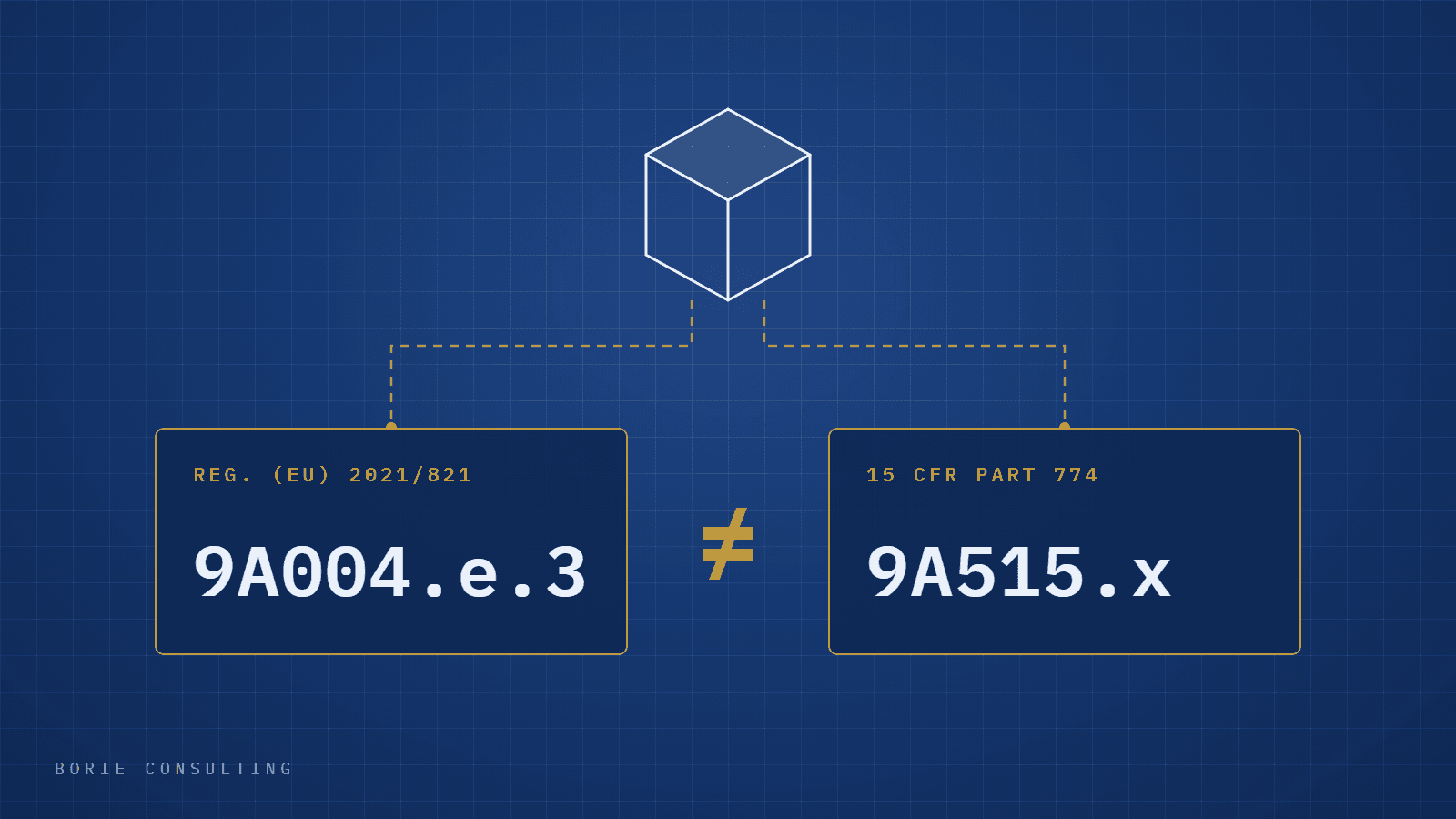
For a unit that stays below the ITAR thresholds, the analysis normally ends at 9A515.x. The same box is therefore 9A004.e.3 for the export from France and, in all likelihood, 9A515.x for the US customer. It is exactly the case of a series that exists only on the US side.
Why the customer asks you. In Toulouse, with no US content, the unit is not subject to the EAR. Once it reaches the United States it is, and your customer needs an ECCN to ship the satellite onward or to send the unit back to you for repair. If your product contains enough controlled US content, it can be subject to the EAR while still in France (see de minimis in our ECCN guide).
Answering the US Customer
- Give the EU code as what it is: “EU Annex I, Regulation (EU) 2021/821: 9A004.e.3”, not an ECCN.
- If you give an ECCN, say whose analysis it is: your own, dated, with the version of the CCL you used. Your customer can still ask BIS for a formal determination.
- Quote the full code. The SBDU makes the point itself: only the complete code identifies precisely what is controlled. 9A004 on its own covers launchers as well as satellites and ground equipment.
- Keep the reasoning: entries read, thresholds compared, list version, date.
The UK and Germany
The UK does not use ECCNs either, but “control list classifications”. Its Dual-Use List keeps the Annex I numbering (9A004.e.3 appears there), alongside a Military List and national controls numbered PL. When a UK partner asks for your “ECCN number”, ask whether they mean the US ECCN or the UK classification.
German partners may ask for the “AL-Nummer”: the number from the Ausfuhrliste, Germany’s national list, which adds military items (0001 to 0022) and nationally controlled items (identifiers 901 to 999) to the EU codes. Watch out for coincidences: the German 9A991 covers low-loader trailers able to carry military vehicles, while the US ECCN 9A991 covers aircraft, gas turbine engines and their parts.
Frequently Asked Questions
Is there an EU ECCN?
Not strictly: the ECCN is American. The EU equivalent is the dual-use classification code, the entry in Annex I of Regulation (EU) 2021/821. Many European companies call it an ECCN out of habit.
Are the dual-use code and the ECCN the same?
Often, but not always. The two lists share a skeleton and many entries, but the regulations differ: some US series (515, 600, 900 to 999) do not exist in the EU, and some EU codes carry a different number in the US.
What is the EU equivalent of EAR99?
There is none. An item missing from Annex I is not classified, has no code, and remains subject to the catch-alls and to any national lists.
Does my US supplier’s ECCN apply in Europe?
No. It is a US classification, useful as a starting point and for the de minimis calculation, but it says nothing certain about the component’s EU dual-use code, or about your product’s. A supplier’s EAR99 does not mean “not in Annex I”.
Can I derive the dual-use code from the customs (HS) code?
No. The SBDU states that there is no correspondence between customs codes and dual-use codes.
What to Take Away
The ECCN answers the US question, the dual-use classification code answers the EU one. The two often look alike, can coincide, and part ways wherever the regulations do. A European company selling into the US often needs both: the dual-use code for its own export, the ECCN for the customer who brings the product into the US system. Either way, give the full code, the list it comes from and the date of your analysis.
At Borie Consulting we classify products on both lists, EU and US, and hand over the reasoning behind each code. See our classification service, and our ECCN guide for the US side in detail.
Codes and texts quoted: versions in force on 10 November 2026.
Going further
Our services on this topic
- Classification & ECCN determination — Determine and document the correct control-list entry for every product, component, software build and technology.
- Export Control & Customs — Export control and customs for controlled technology, from classification to its destination, in one engagement.
Sectors concerned: Aerospace & space · Semiconductors, electronics & AI · Quantum